
Part 3 of a 3-Part IT & Manufacturing Series
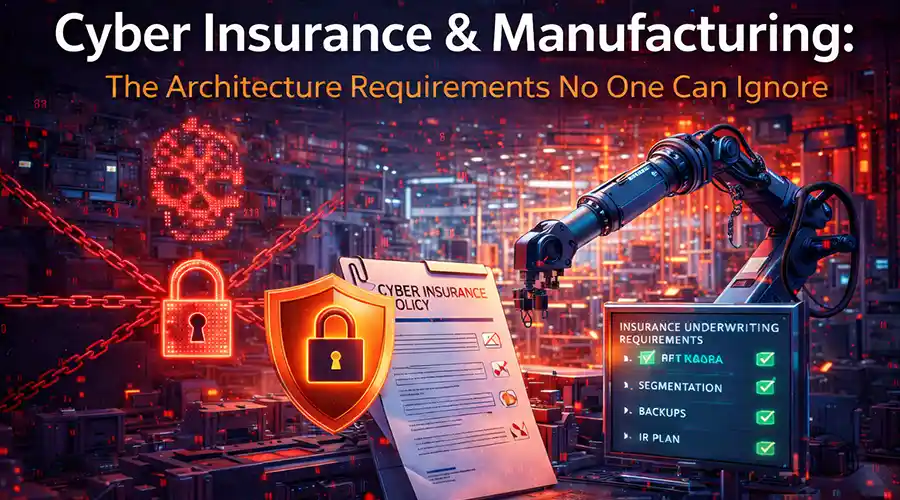
Cyber insurance is no longer a “paperwork layer” on top of security. In 2026, it has become a practical architecture test.
For Texas manufacturers operating across Austin, Houston, and Beaumont, underwriting is increasingly tied to verifiable controls: enforced segmentation, identity governance, immutable recovery, and incident response readiness. Insurers are tightening requirements because ransomware remains the dominant driver of large-loss cyber claims.
This article explains what insurers are looking for, how those requirements map to real manufacturing infrastructure, and what Texas manufacturing leaders should validate immediately.
Summary Navigation
| Jump to Section | What You’ll Learn |
|---|---|
| Why Texas Manufacturers Are Under More Underwriting Pressure | Regional risk factors in Austin, Houston, and Beaumont |
| The 2026 Underwriting Baseline Controls | The minimum controls most carriers now expect |
| OT/IT Segmentation as the Underwriting Pivot | What insurers mean by “segmentation” and how they verify it |
| Immutable Backups and OT Recovery Scope | Why “we have backups” is often not enough |
| Vendor Access, MFA, and the New Remote Access Standard | How insurers score remote access and third-party entry points |
| Texas Manufacturing Insurability Audit Checklist | A practical control validation list for 2026 renewals |
| How to Align Architecture to Underwriting | What to document, test, and improve before renewal |
Why Texas Manufacturers Are Under More Underwriting Pressure
Texas manufacturing environments are often high-impact and uptime-sensitive. Underwriters understand that operational downtime in manufacturing creates immediate leverage for ransomware extortion.
Texas manufacturers also face regional complexity:
- Austin: advanced manufacturing and semiconductor-adjacent operations often involve high-value IP, specialized engineering workstations, and data-intensive production analytics.
- Houston: energy, petrochemical, and engineering ecosystems commonly include dense vendor networks, specialized OT environments, and external connectivity for monitoring and maintenance.
- Beaumont: refining and logistics environments frequently include legacy control systems, long equipment lifecycles, and strict uptime requirements that complicate patching and modernization.
In underwriting terms, these conditions increase both the probability and the severity of claims.
The 2026 Underwriting Baseline Controls
Most carriers now expect evidence-based controls rather than statements of intent. In practical terms, underwriters want to see that key controls are implemented, enforced, and tested.
| Control Domain | Baseline Requirement | What “Proof” Often Looks Like |
|---|---|---|
| Multi-Factor Authentication (MFA) | MFA on all remote access and privileged accounts | SSO/MFA policy screenshots, VPN config, conditional access rules |
| OT/IT Segmentation | Enforced separation between enterprise IT and plant-floor OT | Network diagram, firewall zones, routing rules, VLAN policy |
| Immutable/Offline Backups | Backups protected from encryption and deletion | Immutable storage configuration, retention policy, restore test results |
| Endpoint Detection & Response (EDR/XDR) | Monitoring on endpoints with alerting and retention | Coverage reports, alert workflow, log retention settings |
| Incident Response | Documented and tested response plan | Tabletop exercise records, IR runbooks, contact escalation paths |
These controls are now the difference between normal renewal, restricted coverage, or premium escalation.
OT/IT Segmentation as the Underwriting Pivot
“Segmentation” is often misunderstood. Underwriters are not asking whether VLANs exist. They are asking whether boundaries are enforced in a way that prevents ransomware propagation.
In 2026 underwriting, segmentation generally means:
- Layer-3 boundaries between enterprise IT and OT networks
- Firewall zoning (not just switching separation)
- Explicitly permitted pathways for required services only
- Logging and monitoring of east-west traffic
If an office workstation can route into plant-floor systems during a compromise, containment has failed. That failure increases expected loss severity and drives unfavorable underwriting outcomes.
Preactive IT’s certified technicians help manufacturing organizations implement OT-aware segmentation designed for uptime-sensitive environments. The objective is not “checkbox security.” It is architectural containment aligned to plant operations.
Immutable Backups and OT Recovery Scope
Underwriters increasingly focus on backup immutability and recovery scope because ransomware operators frequently target backup repositories before encryption detonation.
For manufacturing, backup scope must extend beyond servers and file shares. Recovery planning should include OT-adjacent assets that determine production restart time.
| Asset Category | Common Gap | Why It Matters |
|---|---|---|
| Virtualization & Hypervisor Consoles | Admin access not protected; backups reachable from domain | Attackers disable recovery and extend downtime |
| Engineering Workstations | Not included in backup scope | Loss of tooling and configs delays restart |
| OT Configuration Archives | PLC/controller configs not captured | Production restart becomes manual and slow |
| Backup Storage | Not immutable; snapshots deletable | Ransomware neutralizes recovery |
| Restore Testing | No proven restore time objectives (RTO) | Insurers discount untested recovery claims |
In underwriting terms, immutable backups plus tested restores reduce expected loss. In operational terms, they reduce downtime.
Vendor Access, MFA, and the New Remote Access Standard
Manufacturing environments rely heavily on third parties: equipment vendors, integrators, maintenance providers, and software support teams. Remote access is necessary, but it is also one of the most common entry points.
Underwriters increasingly expect remote access to be:
- MFA-enforced for every remote session
- Time-bound (no permanent vendor tunnels)
- Logged with retained access records
- Network-segmented so vendors can reach only what they must
In practical terms, remote access that bypasses identity controls or crosses into OT networks without strict enforcement will raise underwriting concern and can lead to coverage exclusions.
Texas Manufacturing Insurability Audit Checklist
Use the checklist below as a practical control validation set before your 2026 renewal cycle.
| Question | Target State | Evidence to Retain |
|---|---|---|
| Is MFA enforced on all privileged accounts? | Yes, with conditional access policies | Policy screenshots, admin account inventory |
| Is MFA enforced for vendor remote access? | Yes, session-based access only | Remote access policy, access logs |
| Is OT truly segmented at Layer 3? | Yes, with firewall zoning and least privilege routes | Network diagrams, firewall ruleset summary |
| Are backups immutable or offline? | Yes, with retention and access controls | Immutable config, retention policy |
| Do backups include OT-related recovery assets? | Yes, including key configs and engineering endpoints | Backup scope list, asset inventory mapping |
| Are restore tests performed and documented? | Yes, at planned intervals | Restore test reports, RTO results |
| Is EDR/XDR deployed with alert workflows? | Yes, with log retention and triage process | Coverage report, alert escalation workflow |
| Is there a tested incident response plan for plant disruption? | Yes, including production shutdown scenarios | Tabletop notes, IR runbooks |
How to Align Architecture to Underwriting
Approach cyber insurance requirements as engineering inputs, not administrative tasks. In manufacturing, underwriting outcomes improve when controls are enforced, measurable, and tested.
Organizations evaluating long-term it support for manufacturing should ensure their IT partner can design and document industrial-ready controls that satisfy both operational needs and underwriting scrutiny.
If you need to demonstrate control maturity, focus on three deliverables:
- Architecture documentation: network diagrams, segmentation zones, remote access pathways
- Evidence of enforcement: MFA policies, EDR coverage, immutable backup configuration
- Evidence of testing: restore validation, incident response tabletop exercises, access reviews
In 2026, insurability has become an outcome of infrastructure discipline.
Supporting Citation
Coalition Cyber Claims Report (2024)
https://www.coalitioninc.com/resources/reports
IBM X-Force Threat Intelligence Index (2025)
https://www.ibm.com/reports/threat-intelligence
Let’s Talk About Your Cybersecurity Strategy
📞 Call us today: (832) 944-6250
Your customers trust you. Let’s make sure your cybersecurity strategy keeps it that way.

Charles Swihart
CEO, Preactive IT Solutions
Charles Swihart has been at the forefront of the
Managed IT Services industry since founding
Preactive IT Solutions in 2003.